
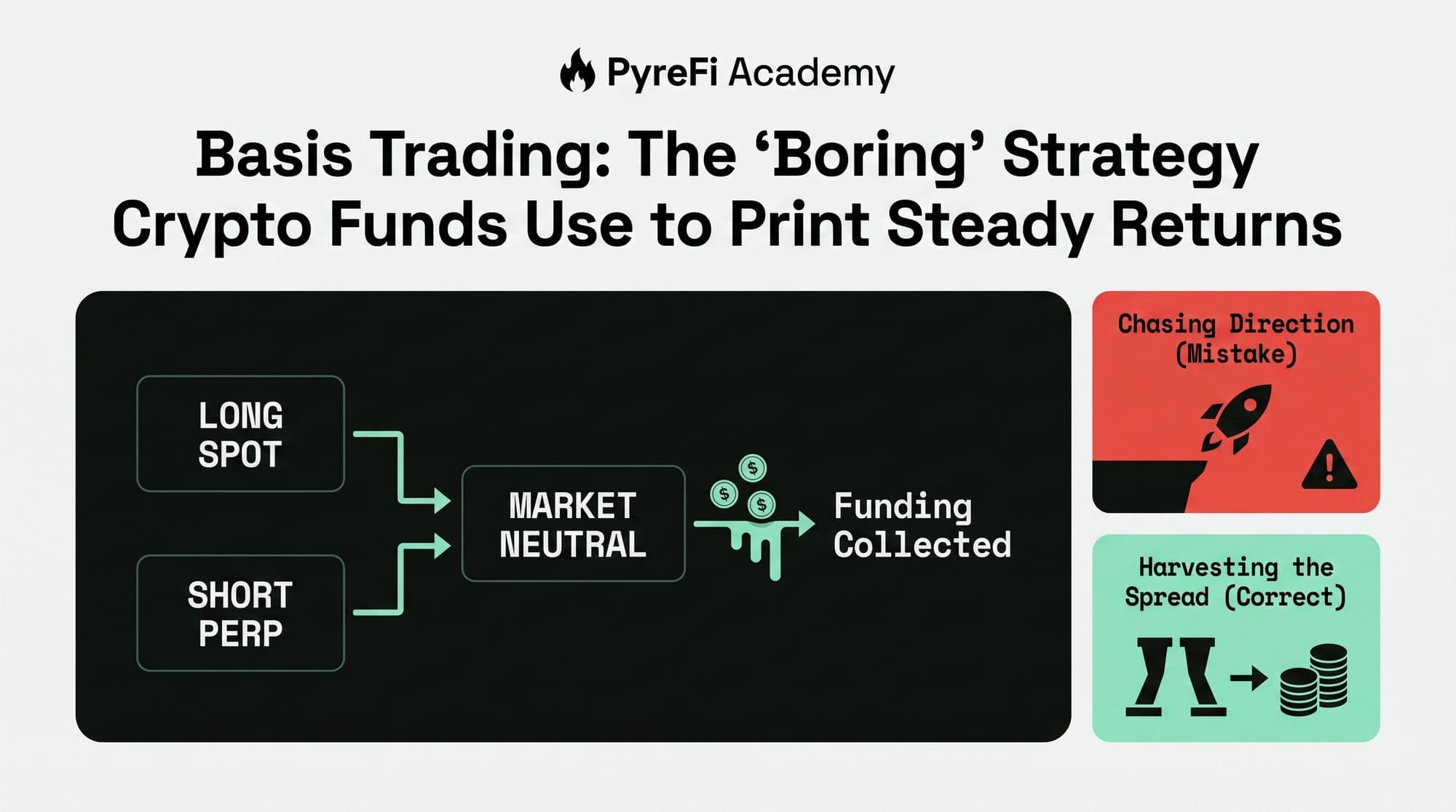
While retail chases 100x moon shots, professionals quietly harvest a spread that barely makes the news.
Retail crypto traders dream of the 100x — the tiny bet that turns into a fortune. Meanwhile, professional funds are quietly running a strategy so unglamorous it barely gets mentioned on X, harvesting steady, relatively low-risk returns year after year. It's called basis trading, and understanding it teaches you something profound about how sophisticated players actually make money in crypto: not by predicting direction, but by collecting structural inefficiencies.
Let's demystify it. You don't have to run it to benefit from understanding it.
What "basis" means
The basis is the difference between the price of a derivative (like a perpetual future) and the spot price of the underlying asset. When the perp trades above spot, the basis is positive; when below, negative.
Recall from perpetual futures mechanics: perps are tethered to spot by the funding rate. When the market is bullish and crowded long, perps trade above spot (positive basis), and funding is positive — longs pay shorts. This is the normal state during bull markets: eager leveraged longs push the perp above spot, and they pay funding for the privilege.
Basis trading is the strategy of capturing that spread and that funding — in a way that's neutral to which direction price actually goes.
The classic basis trade: cash and carry
The most common basis trade is beautifully simple in concept. It's called "cash and carry," and it has two legs:
- Buy the asset on spot (go long the actual coin).
- Short the same amount via perpetual futures (go short the derivative).
Now think about your net exposure. If price goes up, your spot long profits and your perp short loses — roughly canceling out. If price goes down, your spot long loses and your perp short profits — again canceling. You are market neutral: you don't care which way price moves, because the two legs offset each other.
So where's the profit? The funding payments. When funding is positive (the normal bullish state), the short perp leg collects funding from the longs, every funding interval. You're market-neutral on price but continuously collecting the funding fee. That steady stream of funding income is the return.
In essence: you've engineered a position that's indifferent to price direction but harvests the fee that crowded longs are paying. When the market is bullish and funding is high, this can produce attractive, relatively steady yields — while the traders paying you are the leveraged longs chasing the rally.
Why it works and why it's "boring"
Basis trading works because of a structural inefficiency: in bullish crypto markets, leveraged longs are so eager that they persistently pay funding, and someone has to be on the other side collecting it. Basis traders provide that liquidity and get paid for it.
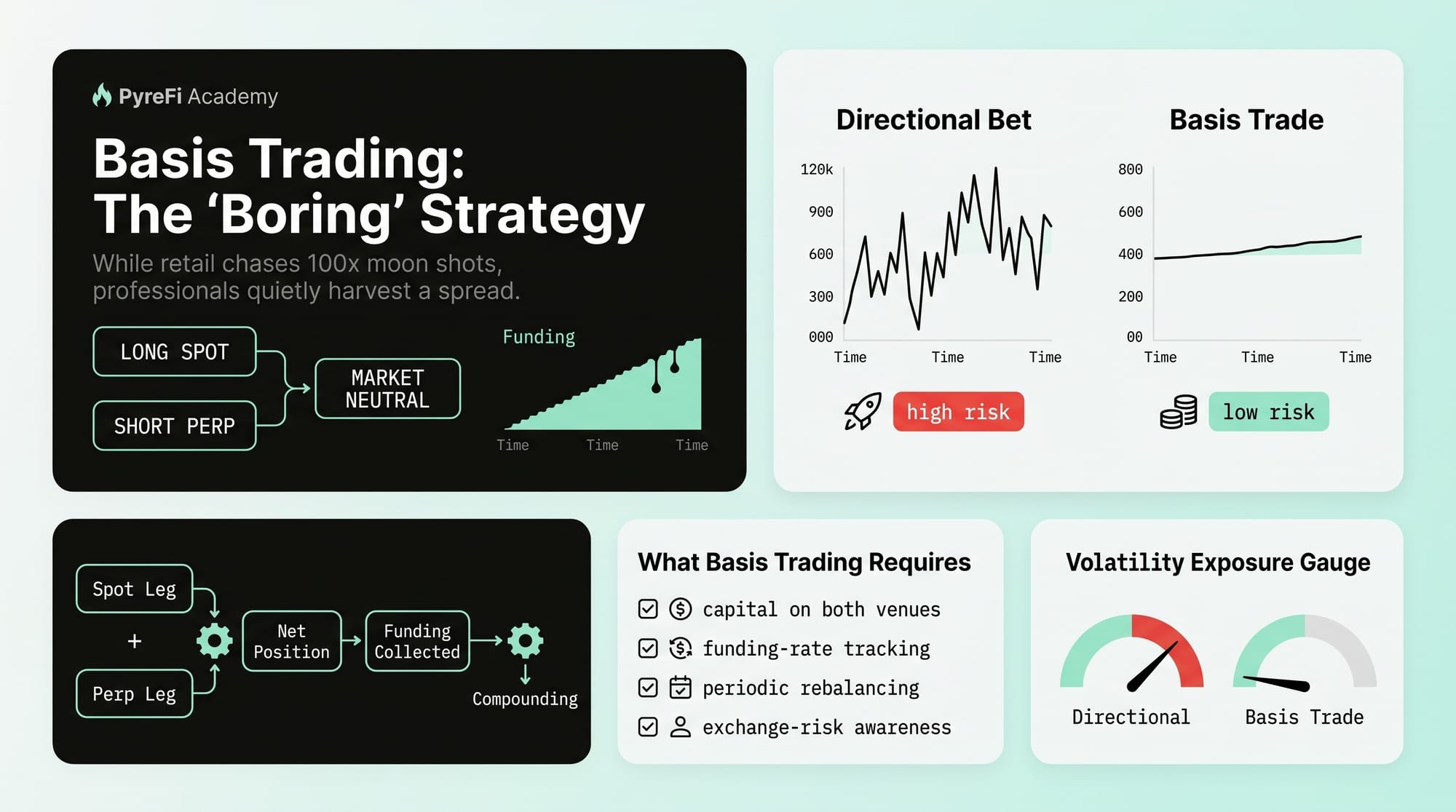
It's "boring" because: - It doesn't depend on being right about direction (no thrilling calls, no moon shots). - Returns are steady and incremental (funding collected over time), not explosive. - It's more about mechanics and execution than market prediction.
But boring is exactly what professionals want. A market-neutral strategy that produces steady returns without needing to predict price is enormously valuable — it's the kind of thing funds build to smooth their returns and reduce reliance on directional bets.
The risks (because nothing is free)
Basis trading isn't risk-free money, and it's important to understand the risks:
1. Funding can turn negative. If the market flips bearish, funding can go negative — and now your short perp leg is paying funding instead of collecting it. The trade's income reverses. Basis traders must monitor funding and manage the position when the regime changes.
2. Execution and liquidation risk. The two legs must be balanced. If price moves violently, the perp short (which is leveraged) can approach liquidation even though the spot long is profiting. Poor management, insufficient margin, or a violent wick can break the hedge and cause real losses. The "market neutral" property only holds if both legs stay intact.
3. Counterparty and platform risk. You're holding spot on one venue and a perp on another (or the same), exposed to exchange risk, withdrawal issues, or platform failure. In crypto, counterparty risk is real.
4. Capital intensity and thin margins. The returns per unit of capital are modest, so meaningful profits require significant capital and tight execution. It's a professional's game partly because of scale.
5. Basis compression. As more players run the trade, the funding they're harvesting gets competed down. Crowded basis trades yield less.
What retail can learn from it
Even if you never run a basis trade, understanding it teaches valuable lessons:
1. You don't have to predict direction to make money. The most sophisticated strategies are often market neutral — profiting from structure, spreads, and inefficiencies rather than directional bets. This reframes trading away from "guess the price" toward "find the edge."
2. Funding is a real, harvestable cost/income. Basis trading makes concrete what funding-rate analysis implies: funding is money flowing between traders continuously. If you're a leveraged long paying high funding, you're literally the person basis traders are collecting from. That's worth knowing.
3. Boring and steady beats exciting and explosive over time. The professionals running unglamorous market-neutral strategies often outlast the retail traders chasing 100x. Consistency compounds; lottery tickets mostly expire worthless.
4. Positioning data reveals opportunity. The persistent positive funding that makes basis trades profitable is the same crowded-long positioning that signals fragility to a directional trader. The same data serves multiple strategies.
The intelligence angle
Running or even monitoring basis opportunities requires tracking the basis and funding across many assets and venues in real time — spotting where the spread is wide, where funding is richest, and where the risk-adjusted opportunity is best. This is precisely the kind of derivatives-wide data that serious market-intelligence systems aggregate. And more broadly, understanding basis reinforces why watching derivatives data (funding, basis, positioning) across the whole market matters: it reveals structural opportunities and risks that are completely invisible if you only watch spot price charts.
The takeaway
Basis trading is the quiet, market-neutral strategy professionals use to harvest the funding that crowded longs pay in bullish markets — buying spot, shorting the perp, and collecting the spread regardless of price direction. It's boring by design: steady, incremental, and dependent on mechanics rather than prediction. It carries real risks (funding flips, execution, liquidation, counterparty), which is why it's a professional's tool.
But the lesson generalizes to every trader: you don't have to predict direction to profit, funding is real money changing hands, and steady structural edges tend to outlast exciting directional gambles. While retail chases the moon shot, the pros are quietly collecting the spread. It's worth understanding which game you're actually playing.
PyreFi tracks funding and basis across the full market — the same derivatives data that reveals directional fragility also surfaces the structural spreads professional strategies are built on.