
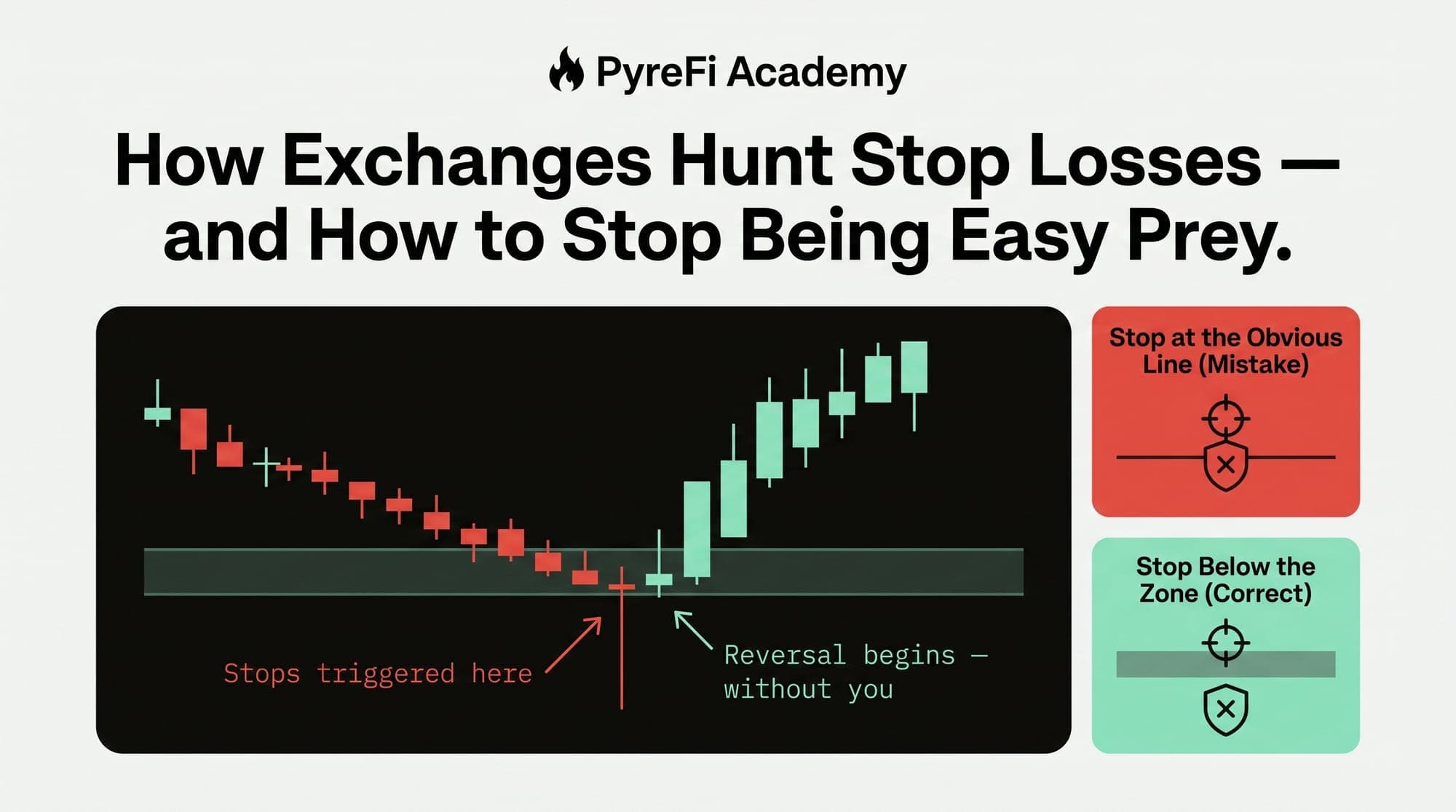
That suspicious wick that took out your stop before reversing wasn't paranoia. Here's the mechanic — and the fix.
You place a long. You put your stop loss just below an obvious support level, exactly where the textbooks say. Price drifts down, spikes sharply through your stop by a hair, triggers it — and then immediately reverses and rockets in your original direction, without you. You were right, and you still lost money.
This isn't bad luck, and it isn't paranoia. It's stop-loss hunting, and it's one of the most common ways traders donate money to larger players. Let's be precise about the mechanic — including the important nuance about who's actually doing the "hunting" — and then, more importantly, how to stop being easy prey.
The mechanic: why stops are targets
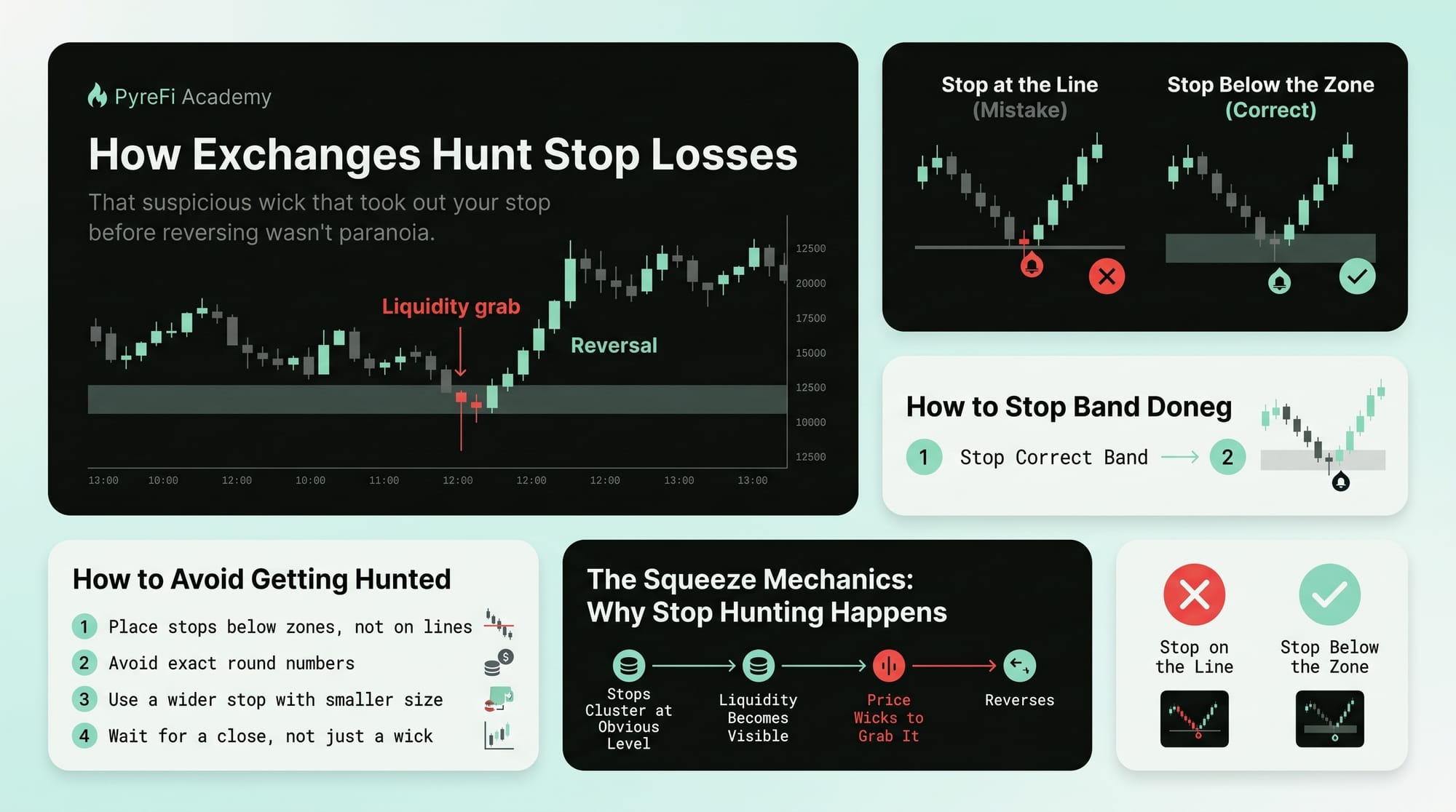
Start with a key fact: stop-loss orders are liquidity. When your stop triggers, it becomes a market order. A long's stop-loss is a sell order; a short's stop-loss is a buy order. And because traders are taught to place stops at "obvious" levels — just below support, just above resistance, below the recent swing low — those stops cluster in predictable zones.
A cluster of stops is a pool of guaranteed orders sitting at a known price. For a large trader who wants to buy, a pool of sell-stops below support is exactly what they need: if price dips into that zone, all those stops fire, dumping sell orders that the large buyer happily absorbs at a discount — filling their large position without having to chase price up. Then, with the weak hands flushed out and their position filled, price reverses.
That's the essence: price gets pushed toward clustered stops because that's where the liquidity is. The stops aren't collateral damage — they're the target.
Who's actually "hunting"? A necessary nuance
The phrase "exchanges hunt stops" is popular but often imprecise. In most cases, it's not the exchange itself manipulating your specific stop — reputable exchanges have little incentive to risk their reputation doing that. The "hunters" are more often:
- Large traders and market makers who read the order book, identify where stops and liquidations cluster, and push price into those zones to grab liquidity.
- The market's own mechanics, where clustered stops and leveraged liquidations create magnets that price naturally gravitates toward, no single villain required.
There are real concerns on some smaller, less reputable venues about manipulation, and thin order books make pushing price trivial. But the practical takeaway is the same regardless of who's doing it: your stop is sitting in an obvious, liquid, predictable place, and that makes it prey. Whether a whale, a market maker, or the market's raw mechanics comes to collect it doesn't change what you need to do.
Why crypto is especially prone
- Thin liquidity. Outside the largest caps, order books are shallow, so it takes little capital to spike price into a stop cluster.
- Visible clustering. Retail crowds into the same "textbook" stop placements, making the clusters obvious.
- High leverage. Leveraged liquidations pile up alongside stops, creating even bigger, more magnetic pools of forced orders.
- 24/7, low-oversight markets. Especially during thin hours, spiking price to grab stops is easy and common.
How to stop being easy prey
The goal isn't to eliminate stops — trading without a stop is far more dangerous. It's to place them intelligently, where they're not sitting in the obvious kill zone. Here's how.
1. Don't place stops at the obvious level. The classic mistake is a stop exactly at support/resistance or exactly at the recent swing low. That's where everyone's stop is — the densest cluster. Instead, give it room: place the stop beyond the level with a buffer that accounts for the typical wick, so a stop-hunt spike doesn't catch you but a genuine break still does.
2. Use structure, not round numbers. Stops at round psychological numbers ($30,000) or just under obvious levels are the most crowded. Place your stop based on where your trade idea is genuinely invalidated — a point that, if reached, means you were actually wrong — not at the spot that "looks" right and where everyone else clusters.
3. Account for volatility (ATR). Use a volatility measure like Average True Range to size your stop distance to the asset's normal movement. A stop tighter than the asset's typical wick is guaranteed to get tagged by noise. Volatility-based stops sit outside the noise band.
4. Trade liquid assets. Stop-hunting is far easier on thin, low-cap tokens. Trading liquid, major assets means it takes enormous capital to push price into stops, so manufactured hunts are rarer and shallower.
5. Consider the retest entry. Instead of buying a breakout (and placing a stop right under the level where hunts occur), wait for the retest to confirm the level held, then enter with a stop beyond the now-confirmed level. This sidesteps the initial fakeout-and-hunt zone entirely.
6. Size down instead of stopping tight. If a proper stop is "too far" for your risk budget, the answer is a smaller position, not a tighter stop. A tight stop in the kill zone just guarantees you get hunted. A wider stop with smaller size keeps the same dollar risk while sitting safely outside the cluster. (This is the position-sizing lesson applied directly.)
7. Recognize the setup and use it. Once you understand stops-as-liquidity, you can anticipate hunts. When price is coiling just above an obvious stop cluster below support, a spike down to grab those stops before reversing up is a common pattern. Sophisticated traders wait for that flush and buy into it — turning the hunt into their entry rather than their exit.
The mindset shift
The deepest fix is a mental one: stop thinking like the crowd. Stop-hunting works precisely because most traders do the obvious, predictable thing — same levels, same stops, same round numbers. The moment you place your stops where the crowd doesn't, based on genuine invalidation and adjusted for volatility, you stop being the easy liquidity that hunts target. You can't be flushed out of the obvious zone if your stop isn't in it.
Why this connects to market intelligence
Understanding where stops and liquidations cluster — and how price gets drawn to that liquidity — is part of reading market microstructure, the actual mechanics beneath the price. Systematic approaches that analyze order flow and liquidation clustering can identify these liquidity magnets and factor them into how they read a move, distinguishing a genuine break from a liquidity grab. It's the same skill a sharp discretionary trader develops — seeing the stop clusters as targets — applied systematically across the market. The manufactured stop-hunt spike is designed to look like a breakdown; reading the microstructure is how you tell the difference.
The takeaway
Stop-loss hunting is real, though it's usually large traders, market makers, and the market's own liquidity mechanics doing the hunting rather than the exchange itself. Your stops are liquidity, they cluster at obvious levels, and price gets drawn to those clusters like a magnet. The fix isn't to abandon stops — it's to place them intelligently: beyond obvious levels with a buffer, based on genuine invalidation, sized to volatility, on liquid assets, with smaller position sizes rather than tighter stops.
Stop being predictable, and you stop being prey. The wick that took out your stop before reversing wasn't bad luck — it was a lesson in where not to put your stop next time.
PyreFi reads market microstructure — including where liquidity and liquidations cluster — to distinguish a genuine break from a liquidity grab, the same skill a sharp trader uses to avoid getting hunted.