
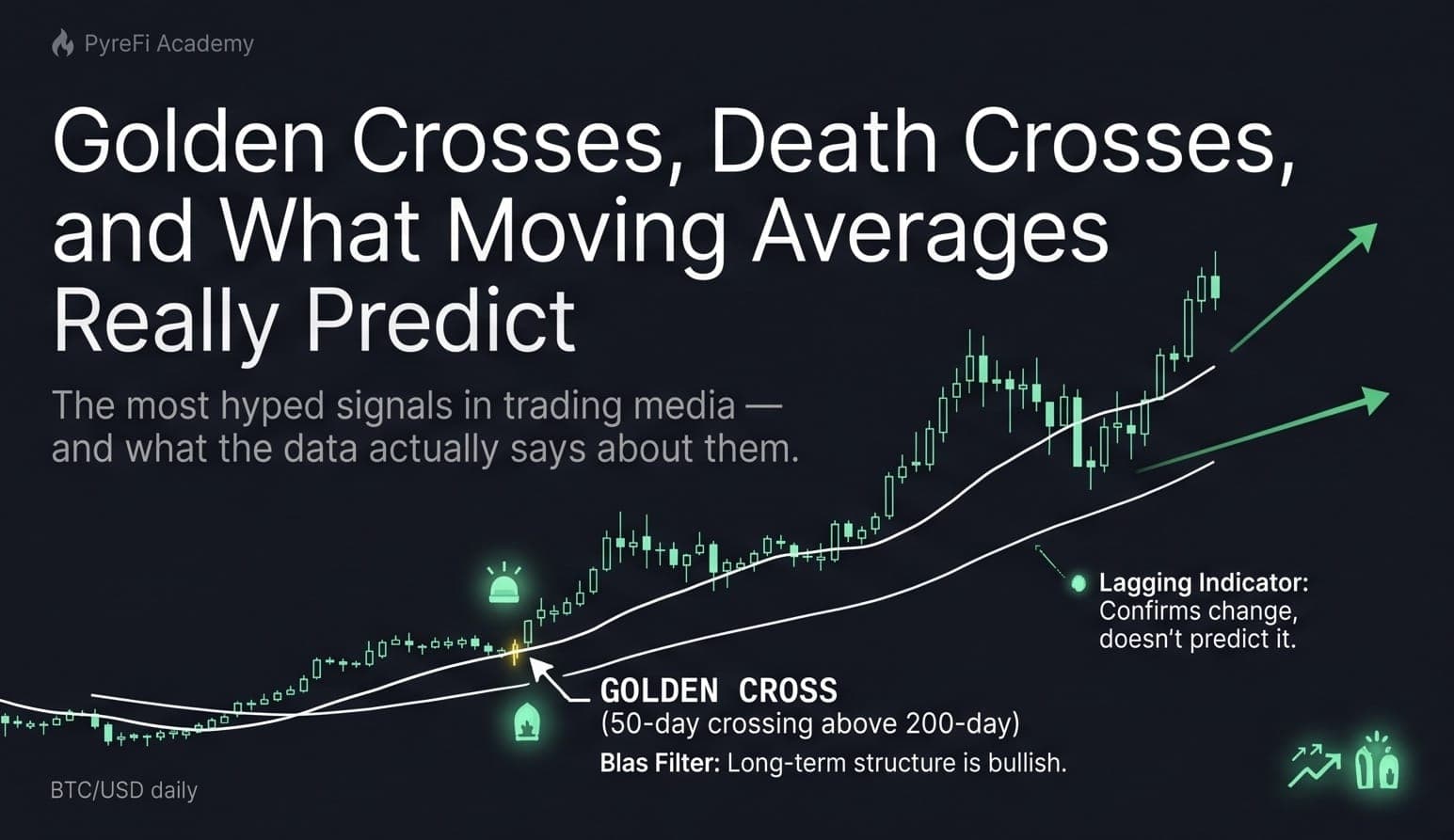
The most hyped signals in trading media — and what the data actually says about them.
Every few months, crypto headlines light up: "Bitcoin Forms Golden Cross!" or "Death Cross Signals Doom!" These two moving-average crossovers get more media attention than almost any other technical signal. They sound dramatic, they're easy to spot, and they make great headlines.
They're also widely misunderstood. Golden and death crosses aren't the predictive magic they're portrayed as — but they're not useless either. Let's separate what they actually do from the hype, starting with what moving averages really are.
What a moving average is
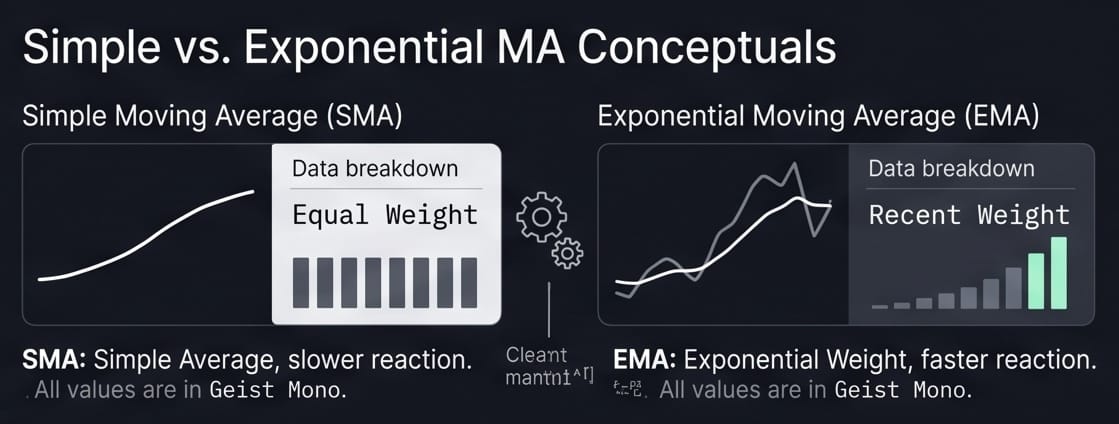
A moving average (MA) smooths price into a single flowing line by averaging it over a set number of periods. A 50-day MA plots the average closing price of the last 50 days, updated each day. This filters out the day-to-day noise and reveals the underlying direction.
There are two common types: - Simple Moving Average (SMA): a plain average of the period's closes. - Exponential Moving Average (EMA): weights recent prices more heavily, so it reacts faster to new moves.
The key thing to understand: a moving average is a lagging indicator. It's built entirely from past prices, so it always tells you where price has been, not where it's going. This single fact explains almost everything about how crosses behave.
What the crosses are
- A Golden Cross occurs when a shorter-term MA crosses above a longer-term one — classically the 50-day crossing above the 200-day. It's read as a bullish signal: the medium-term trend has turned up relative to the long-term trend.
- A Death Cross is the opposite — the 50-day crossing below the 200-day — read as bearish.
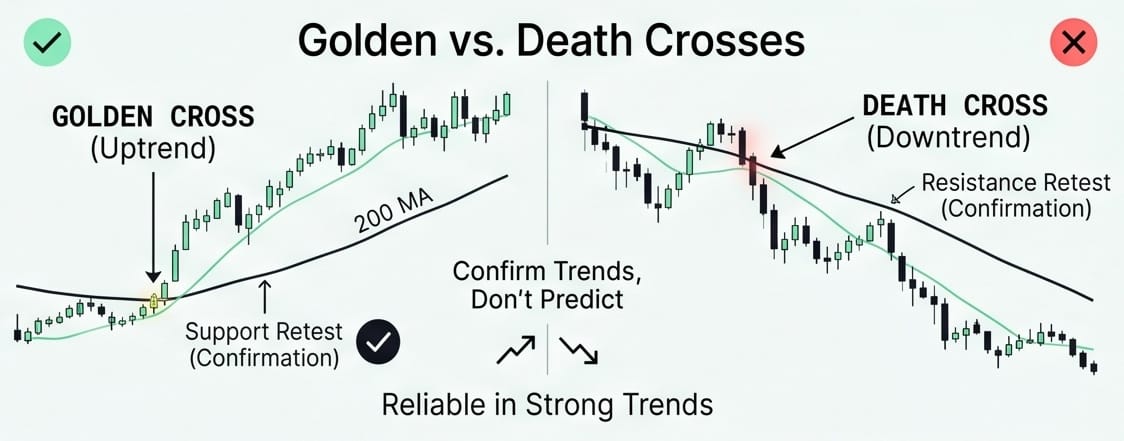
The logic is intuitive: when recent average prices rise above longer-term average prices, momentum has shifted upward, and vice versa. That intuition isn't wrong. But it comes with heavy caveats.
What they actually predict (and what they don't)
Here's the honest assessment.
They confirm trends; they don't predict them. Because MAs lag, a golden cross happens after a significant amount of the up-move has already occurred. By the time the 50-day climbs above the 200-day, price has usually rallied substantially. The cross confirms that a trend change has already happened — it doesn't forecast one before it does. Treating it as a "buy signal" often means buying well after the easy gains are gone.
They're most reliable in strongly trending markets. In a sustained bull or bear market, crosses do a decent job of keeping you on the right side of the dominant trend. Their value is as a regime filter: "the long-term structure is now bullish" is genuinely useful context.
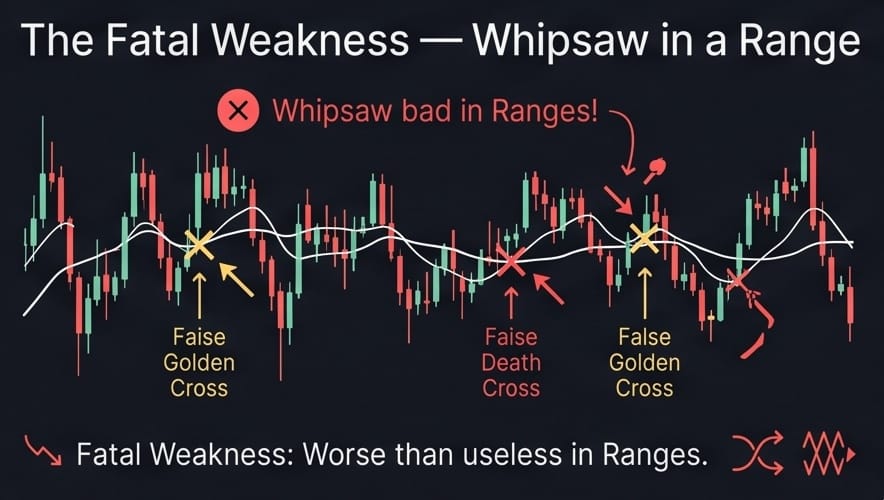
They whipsaw badly in ranging markets. This is their fatal weakness. When price chops sideways, the two MAs cross back and forth repeatedly, generating a string of false golden and death crosses in quick succession. Each one looks like a signal; each one traps traders. In a range, crosses are worse than useless — they're actively misleading.
Their reputation creates some self-fulfilling movement. Because so many traders and so much media watch the 50/200 cross, it can generate short-term reactions simply because everyone's looking at it. But this effect is modest and unreliable — don't build a strategy on it.
The lag problem in numbers
Consider what "50-day crossing 200-day" really means. For the shorter average to climb above the longer one, price has to have risen consistently for weeks. The cross is essentially a heavily delayed confirmation of a move that began long ago. In fast markets — and crypto is often very fast — that delay can be enormous. Price can rally 50% before the golden cross prints, then correct sharply right as retail piles in on the "signal."
This is why experienced traders treat crosses as context, not triggers. The golden cross tells you "the long-term regime is bullish." It does not tell you "buy right here, right now." Those are completely different statements.
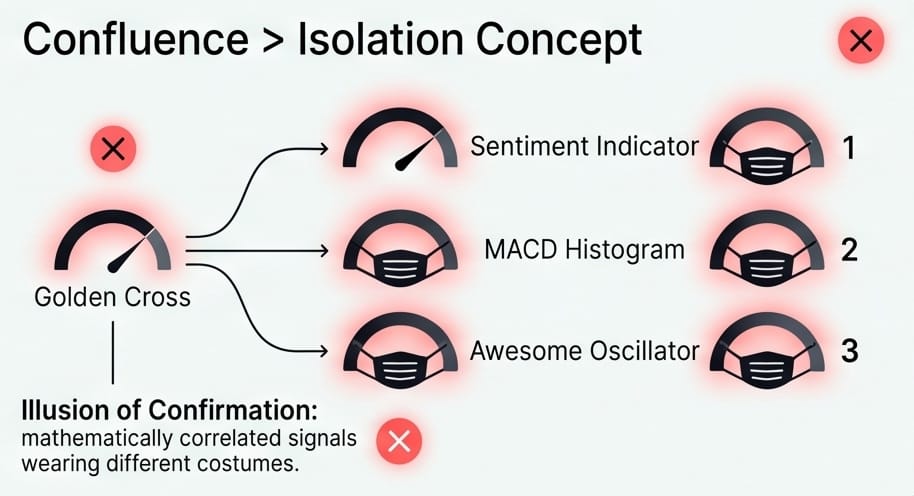
How to actually use crosses well
Despite the hype problem, moving-average crosses have a legitimate place. Here's how to use them without getting burned:
1. Use them as a regime filter, not an entry. Let the golden cross define your bias — "I'll favor long setups while the structure is bullish" — and then use other tools (support/resistance zones, momentum, volume) to time actual entries. The cross sets the direction; something faster sets the timing.
2. Combine with market-state awareness. Before trusting any cross, ask: is this market trending or ranging? In a clear trend, crosses are meaningful. In a chop, ignore them entirely — you already know they'll whipsaw.
3. Watch the retest, not the cross itself. After a golden cross, a healthy uptrend often pulls back to test the rising moving averages as support. That retest is usually a far better entry than the cross itself — better price, defined risk, and confirmation that the level holds.
4. Consider the slope. A golden cross where both MAs are rising steeply is more meaningful than one where they're crossing while nearly flat. Flat MAs crossing is often just the beginning of a whipsaw.
5. Don't trade on the headline. By the time "Golden Cross!" is a news headline, the signal is fully public and often already priced in. The edge, if any, was long before the media noticed.
The bigger lesson about lagging indicators
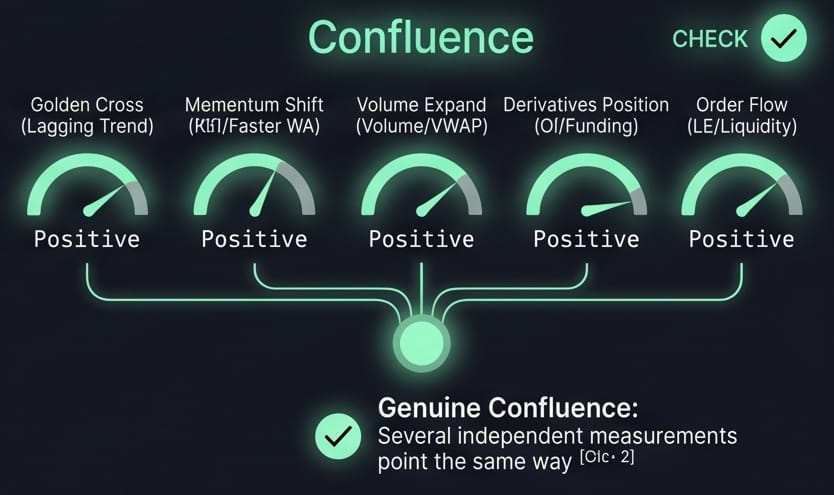
Golden and death crosses are a perfect case study in a universal truth: lagging indicators confirm, they don't predict. This isn't a flaw to fix — it's the nature of anything built from past prices. The mistake is expecting prediction from a tool that can only offer confirmation.
Sophisticated systems account for this by combining lagging indicators (for trend confirmation) with faster, more forward-looking data — momentum shifts, volume changes, derivatives positioning, order flow — that can hint at moves before the lagging averages catch up. A moving-average cross is one input among many, valued for what it is (regime confirmation) and not asked to be what it isn't (a crystal ball).
The takeaway
Golden crosses and death crosses are real, useful signals wrapped in far more hype than they deserve. They confirm that a trend regime has changed — but only after much of the move is done, and they whipsaw relentlessly in ranging markets. Use them as a bias filter, not a trigger. Time your actual entries with faster tools and structural levels. Respect the retest over the cross. And never, ever trade on the headline.
Understand what a lagging indicator can and can't do, and the death cross stops being a horror-movie jump-scare and becomes what it actually is: one modest, honest piece of trend context.
PyreFi treats trend-confirmation signals like MA crosses as one input among many, pairing them with faster momentum, volume, and derivatives data that can move before the lagging averages do.