
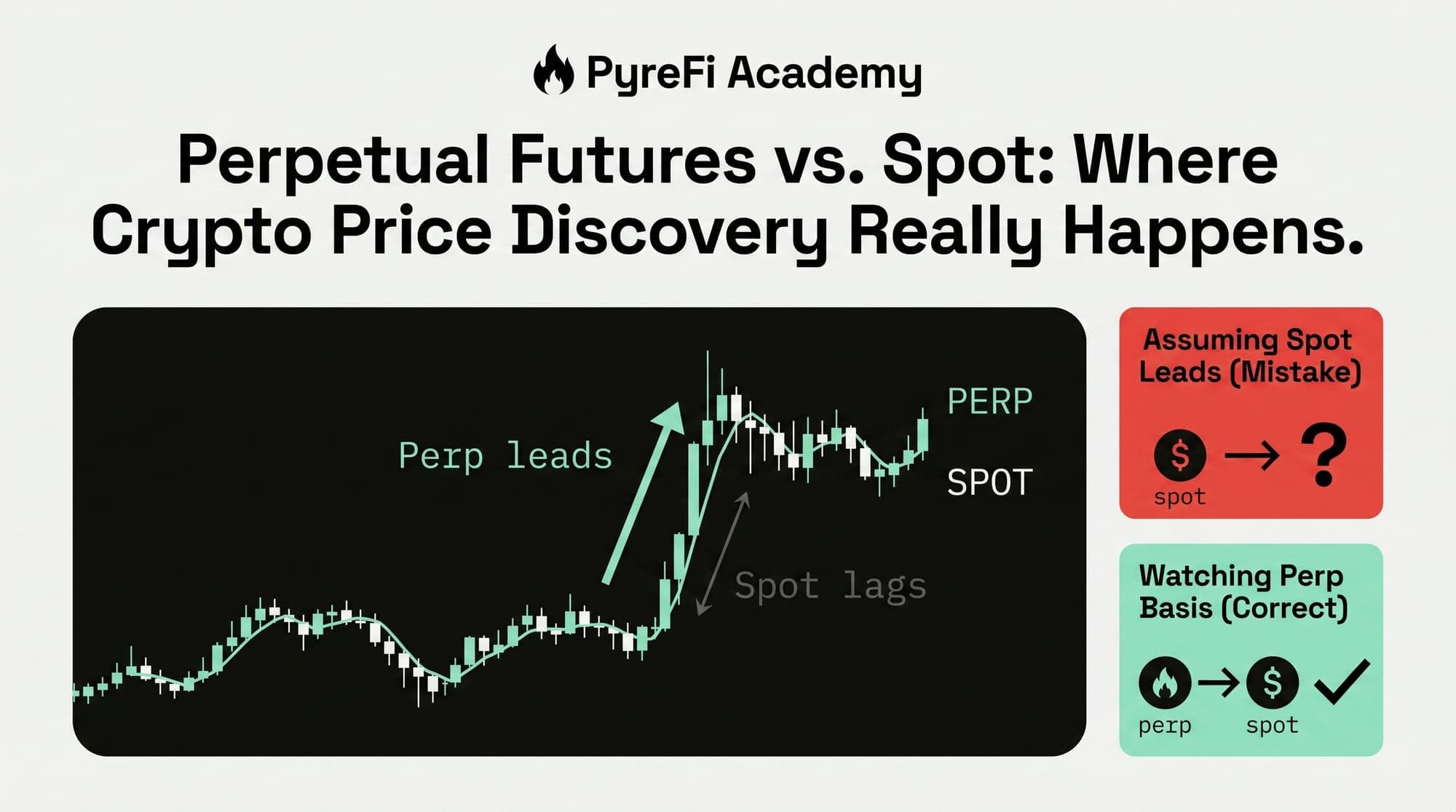
Most people think spot sets the price. In crypto, the derivatives tail often wags the dog.
Ask a beginner where the price of Bitcoin "comes from" and they'll point to spot markets — people buying and selling actual coins. It seems obvious: spot is the real thing, derivatives are just bets layered on top. But in crypto, this intuition is often backwards. A huge share of price discovery — the process by which the market decides what an asset is worth — actually happens in the derivatives market, specifically perpetual futures. The tail frequently wags the dog.
Understanding the relationship between perps and spot is essential to understanding how crypto prices actually move. Let's build it up.
Spot markets: owning the actual asset
A spot market is straightforward. You buy Bitcoin, you own Bitcoin. You sell it, it's gone from your wallet. Prices reflect real supply and demand for the actual asset, settled immediately ("on the spot"). No leverage inherent to the transaction, no expiry, no borrowing — just ownership changing hands.
Spot is the foundation of crypto and, in a sense, the "truest" price — it's what the asset actually trades for when real ownership transfers. For long-term investors, spot is usually where they operate.
Perpetual futures: leveraged bets with no expiry
A perpetual future ("perp") is a derivative — a contract whose value tracks an underlying asset, letting you bet on its price without owning it. Perps have two defining features:
- Leverage: you can control a large position with a small amount of capital. This amplifies both gains and losses.
- No expiry: unlike traditional futures, perps never settle on a date. You can hold indefinitely, tethered to spot by the funding rate mechanism.
Perps are wildly popular in crypto because they let traders speculate with leverage, go short easily, and trade around the clock without ever taking custody of the asset. And here's the critical fact: perpetual futures volume dwarfs spot volume in crypto. Far more money flows through perps than through spot markets. That imbalance is why derivatives often lead.
Why derivatives lead price discovery
If perps are just bets on spot, how can they lead the price? Several reasons:
1. Sheer volume and leverage. Because perp volume is so much larger than spot, and because leverage amplifies the impact of each dollar, aggressive positioning in perps can move price with more force than spot flows. When leveraged traders pile in, their buying/selling pressure — magnified by leverage — pushes the perp price, and arbitrage drags spot along.
2. Speed and accessibility. Perps are where fast money lives — traders reacting to news, momentum, and positioning in real time, with leverage, 24/7. Spot buyers (especially long-term holders) move slower. So new information often hits the perp market first and gets reflected there before spot fully adjusts.
3. The arbitrage link. Perps and spot are chained together by arbitrage and the funding mechanism. If perps run ahead of spot, arbitrageurs step in — buying the cheaper market, selling the richer one — pulling the two back together. But this means a move that originates in perps gets transmitted to spot. The perp led; spot followed.
4. Positioning-driven moves. Much of crypto's violent action — squeezes and liquidation cascades — is a purely derivatives phenomenon. Leverage building in perps, then unwinding, drives enormous price moves that have nothing to do with spot supply and demand and everything to do with derivatives positioning. Spot just gets dragged along for the ride.
The upshot: in crypto, you often cannot fully understand price by watching spot alone. The forces driving the move are frequently in the derivatives market — in funding, open interest, and leverage dynamics that a spot-only view is completely blind to.
What this means for traders
1. Watch derivatives even if you trade spot. Even a pure spot investor benefits from watching perp data. The funding rate, open interest, and long/short positioning in perps often reveal the pressures that will move spot price. Ignoring derivatives means missing the actual drivers.
2. Understand basis — the spread between perp and spot. The difference between the perp price and spot price (the "basis") is informative. A large positive basis (perp well above spot) signals aggressive leveraged bullishness — and fragility. This spread is the raw material for basis trading strategies and a useful sentiment read.
3. Recognize derivatives-driven moves for what they are. When you see a violent move, ask: is this spot-driven (real buying/selling of the asset) or derivatives-driven (a squeeze or cascade unwinding leverage)? Derivatives-driven moves often overshoot and snap back, because they're mechanical rather than reflecting a genuine revaluation. Reading them correctly changes how you react.
4. Spot is the anchor; perps are the amplifier. Over the long run, spot supply and demand set the fundamental value. But in the short-to-medium term, perps amplify, accelerate, and often initiate the moves. Both matter, on different horizons.
The risk dimension
For traders, the perp-vs-spot distinction is also a risk decision. Spot has no liquidation risk — you own the asset, and even if price crashes, you still hold it. Perps carry leverage and therefore liquidation risk, which is precisely what makes cascades possible. Beginners often gravitate to perps for the leverage and the ease of shorting, without appreciating that they've entered the market segment where forced liquidations, funding costs, and squeeze dynamics live. Many blown-up accounts trace directly to trading perps without respecting the leverage.
The general guidance: use spot for conviction holdings and long-term exposure; use perps deliberately and with modest leverage for shorter-term, risk-managed trades — never as a way to secretly over-leverage a long-term bet.
Why full-market intelligence spans both
Because price discovery in crypto is split across spot and derivatives, understanding the market requires watching both — and the relationship between them. This is exactly why serious market-intelligence platforms ingest spot data and derivatives data (funding, open interest, basis, liquidations) together. A signal that considers where price is on spot and how leverage is positioned in perps is fundamentally richer than one looking at spot candles alone. The derivatives layer often reveals why a move is happening and how fragile it is — information invisible to a spot-only view, and essential to reading crypto correctly.
The takeaway
Spot markets involve owning the actual asset and represent the "truest" price, but in crypto, perpetual futures — with their enormous volume, leverage, and 24/7 fast money — often lead price discovery. The tail wags the dog: moves frequently originate in derivatives and get transmitted to spot through arbitrage. Squeezes and cascades, some of crypto's most violent action, are purely derivatives phenomena.
If you only watch spot, you're watching the shadow, not the source. Understand both markets and the relationship between them — and you'll finally see where crypto prices actually come from.
PyreFi ingests spot and derivatives data together — price, funding, open interest, and basis — because in crypto, understanding a move often means reading the leverage market that drove it.